

Six days, around 150 nautical miles, and one night when the boat lay pointing at the rocks at midnight. In between: a botched marina departure, the jib jammed at 25 knots, a storm that just missed us — and dolphins right under the hull. The kind of family holiday you don't forget, and don't entirely want to repeat.
The crew: Boris on the helm; Suzan, who somehow ran a whole floating household out of a galley the size of a cupboard; Vicky; and the two who slept on deck and treated every crisis as the best part of the day, Rick and Jan. Five people, a thirty-six-foot Dufour, and a week that quietly, thoroughly tested every one of us.
A departure we'll be careful with next time
We rolled into ACI Marina Trogir with the particular optimism of people who have not yet made their first mistake. Check-in in the office dragged on until nearly one; the boat — a Dufour 360 with a name that gives nothing away, Sileb — was finally ours at half past three. Then the unglamorous choreography every charter begins with: a serious shop for five, six ten-litre cans of water stowed on deck (they saw us through to Wednesday), and the galley solved the way we always solve it — most of the week's food cooked and jarred at home, waiting only to be warmed through aboard.
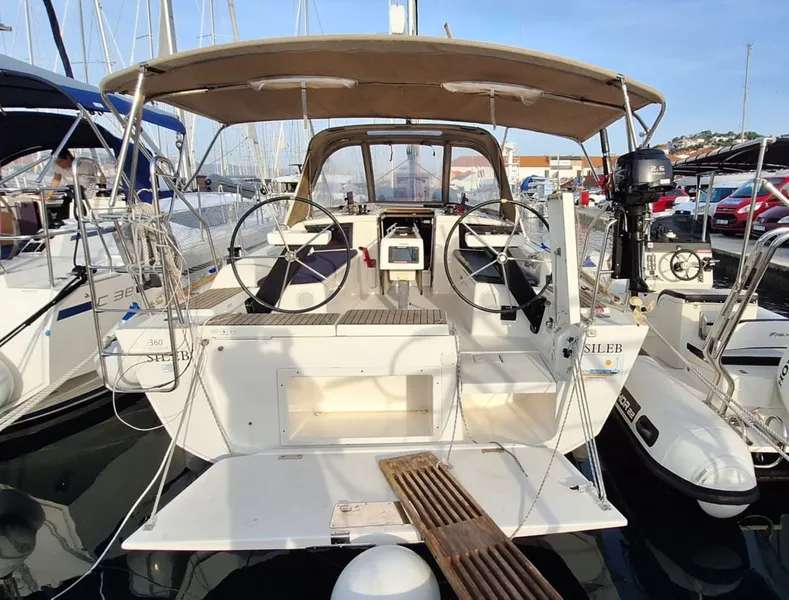
Leaving the marina should have been a formality. Instead, in a flat, oily calm with not a breath of wind to blame it on, we made the first mistake of the trip: we let go a single stern line, and Sileb — heavy, unhurried, entirely within her rights — began to slide sideways onto the yacht in the next berth. A short, undignified scramble of fenders and raised voices, and no harm done. But the lesson stuck, and we kept it for the rest of the week: in a calm, slip both stern lines together, a gentle nudge of throttle ahead, and let the rudder do the turning — no bow thruster, no drama. Every departure after that one was clean.

First anchor, first line ashore
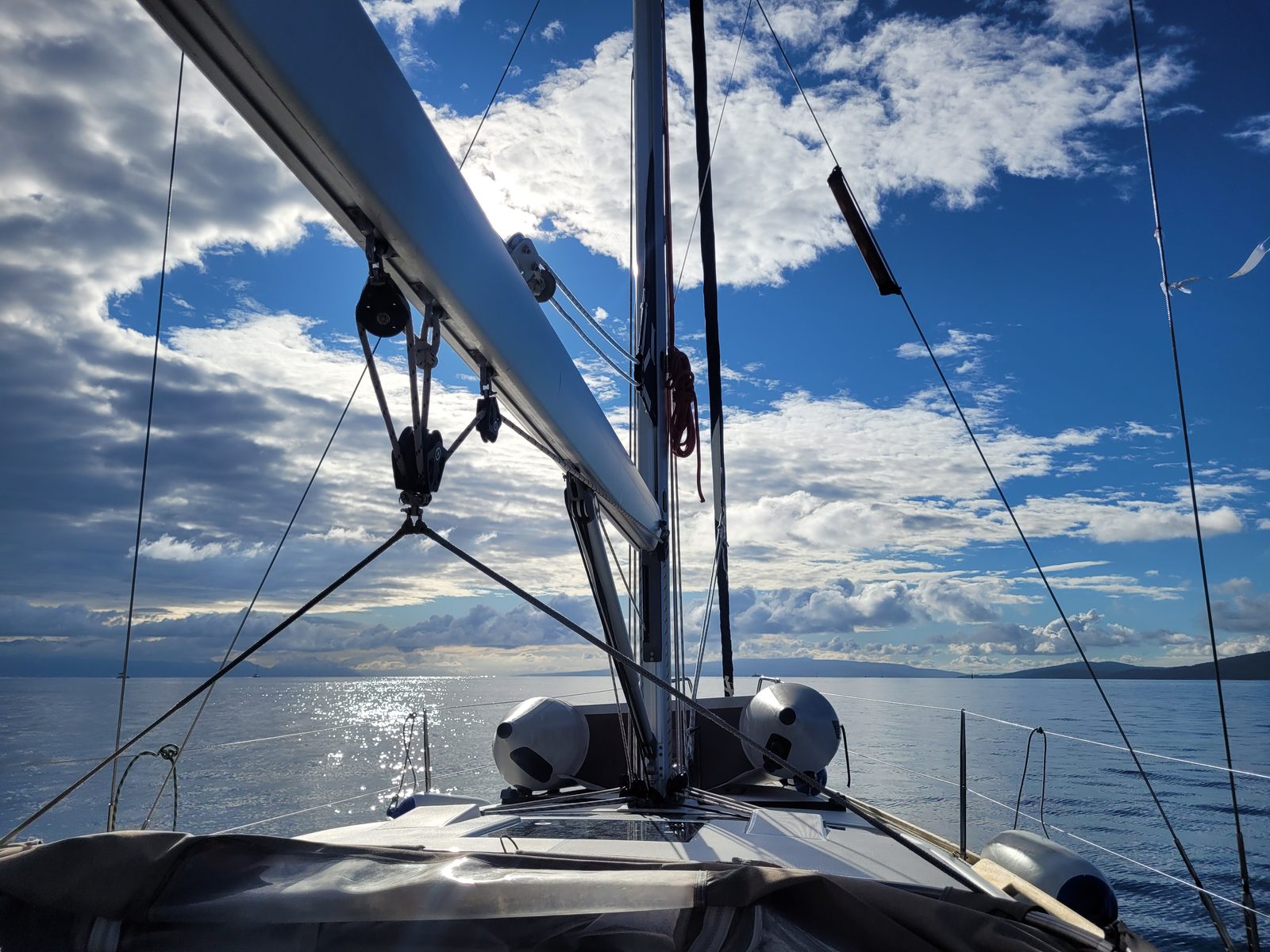
Lines off into a calm, bright morning, the engine ticking us south at a patient five knots, islands opening on either hand like a slow deal of cards. We broke the run for lunch at anchor off Žukova Beach — swim, eat, doze, the finest kind of nothing — and then carried on to the day's real target, Uvala Mala Stiniva on Hvar.
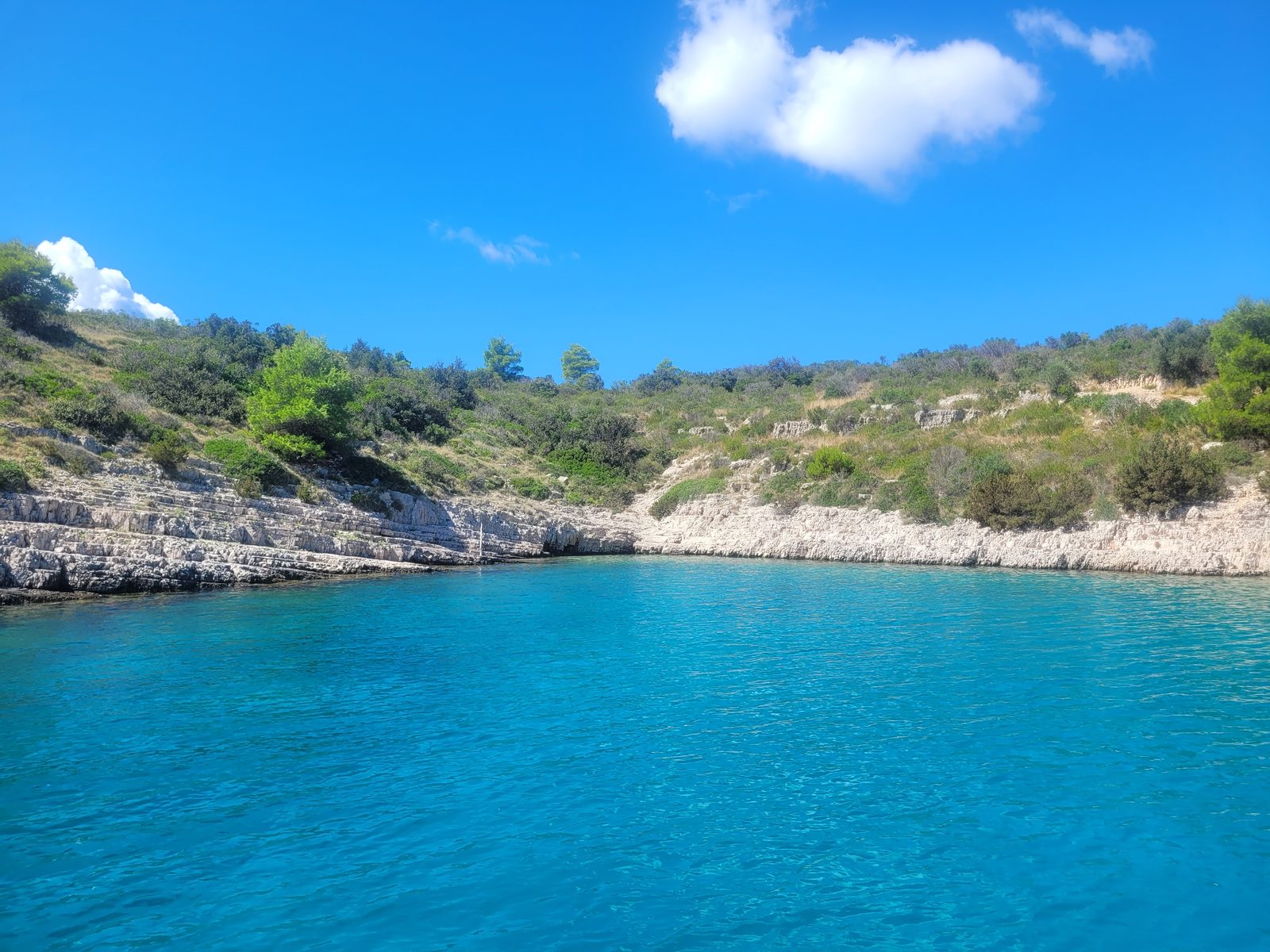
Here we rehearsed for the first time the manoeuvre that would become the rhythm of the whole week: two of us away in the dinghy to loop a line around a rock ashore, the boat feeling her anchor down, then backing gently toward the land until she squared off between chain and shore line, the line snubbed through the cleat with a fender rigged against the chafe. It held beautifully. A quiet, star-heavy night followed; Rick and Jan claimed the deck, as they would every night after, asleep under the red glow of a camping lamp. First evening, first "everything's fine" — with no idea at all what a few days would bring.
An easy day — and a booking, just in case
A gentle day's sail, a long lunch stop, and by afternoon the anchor and a line ashore in Uvala Križica near Pelješac. Everything held — chain, shore line, and a windless night that let the whole crew sleep, the boys on deck again under the same red light. On paper, the easiest day of the week.
But the forecast had begun to repeat itself, and you learn to listen when it does: a storm, it kept saying, from Tuesday into Wednesday. So we did the un-heroic, sensible thing and used the Navily app to book a berth in a sheltered harbour a full day ahead of the weather. It would turn out to be one of the best decisions of the trip.
The forecast said 10 knots. The sea disagreed
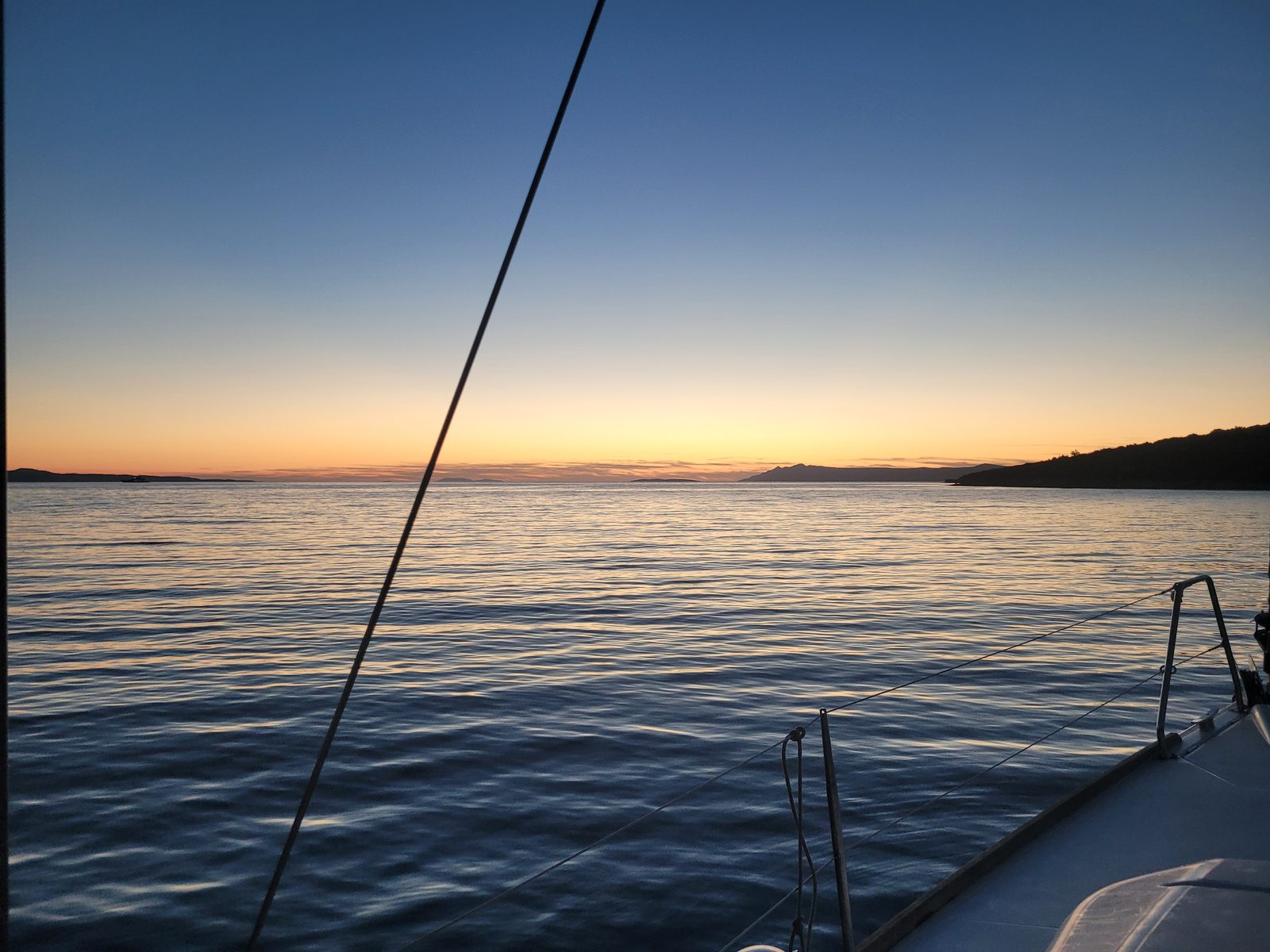
Windy had promised something like ten knots for the channel between Pelješac and Hvar. What the sea actually served up was a short, high chop and a steady twenty. We committed to it: push across the channel, get in under the Hvar coast where the wind would swing round behind us, and carry that following breeze on toward harbour. Jan went quietly green somewhere mid-channel — but the moment we rounded the tip of Hvar and put the wind astern, the motion eased, the sun found us, and Jan came back to the living as suddenly as he'd left it.
The day's real mistake was mine. Heads-down in a busy crossing, I let the weather slip out of my attention — and a storm warning arrived, unbidden, from the charter base to remind me of it. The sky greyed, showers loitered on the horizon and thought about it. In the end they thought better of it: we came calmly onto the quay at Pučišća on Brač, a jewel of a little harbour folded into a sheltered bay, and spent the evening ashore. The heavy overnight blow we'd braced for tracked away to the north; over us it managed only a drizzle. The berth came with water and power and, better still, the soundest night's sleep of the week.

"A forecast is an opinion. The sea always has the last word — and that morning we hadn't asked it carefully enough."
A jammed jib, and the night we drifted toward the rocks
This time the marina let us go cleanly — Day 1, duly learned. Out on the water the wind built through the morning, nine to twelve and later fifteen knots, all of it on the nose. We tried the main at half and it flogged itself ragged the moment we bore away, so down it came. The jib was the day's real trouble: in eighteen to twenty knots, gusting twenty-five, in the funnel between Šolta and Veli Drvenik, the furler jammed — the sail a quarter unrolled and slatting, the furling line bunched somewhere deep in the drum. It took several careful, teeth-gritted attempts before the line ran free and let us wind the sail safely away.
We anchored in Uvala Kokošinje on Drvenik Veli with a line ashore, seven and a half metres under the keel, and thought the hard part was behind us. It wasn't. A tireless swell came marching in from the open sea, and by eleven that night it had swung Sileb until she lay pointing her bow straight at the rocks. We tried the gentle fixes first — ease the shore line, motor up a little — and the sea refused every one. There was nothing for it but to lift the anchor and set it again, in the dark, in the surge.
Rick and Jan went ashore in the dinghy with the slipped lines, ready to bring them back once the anchor was reset — but it bit too soon, and we couldn't work the boat close enough to reach them. We shouted instructions the surge swallowed whole. A fender worked loose and set off into the black on its own; we chased it down and hauled it aboard. In the end the boys came back hand-over-hand along the line, and once we had everything back on deck they christened the whole shambles "the Normandy landing." I stood watch until five in the morning, Sileb rolling and sheering around her chain the entire night. Thank God for a locker full of head-torches. By first light the verdict was unanimous: move to the next bay.

A day to recover — and dolphins under the boat
After a night with no sleep in it, we asked almost nothing of the morning — a short hop to the glassy calm of Uvala Krknjaši, the local "blue lagoon," where we ate and dozed and let the water put the previous night at a distance. Around ten we finally roused ourselves for the day's proper destination, Uvala Nečujam on Šolta. The wind extracted one last re-anchor from us — a side gust nudging Sileb toward a neighbour — and then, at last, she sat still and stayed still.
And then the week paid us back all at once: dolphins — right under the hull. No drama to it, no adrenaline, none of the theatre of the last two days — just quiet, clear water and the dark, unhurried curve of dolphin backs a few metres off the deck. We swam, we rested, we slept. After the night we'd had, it was precisely, exactly what we'd been owed.
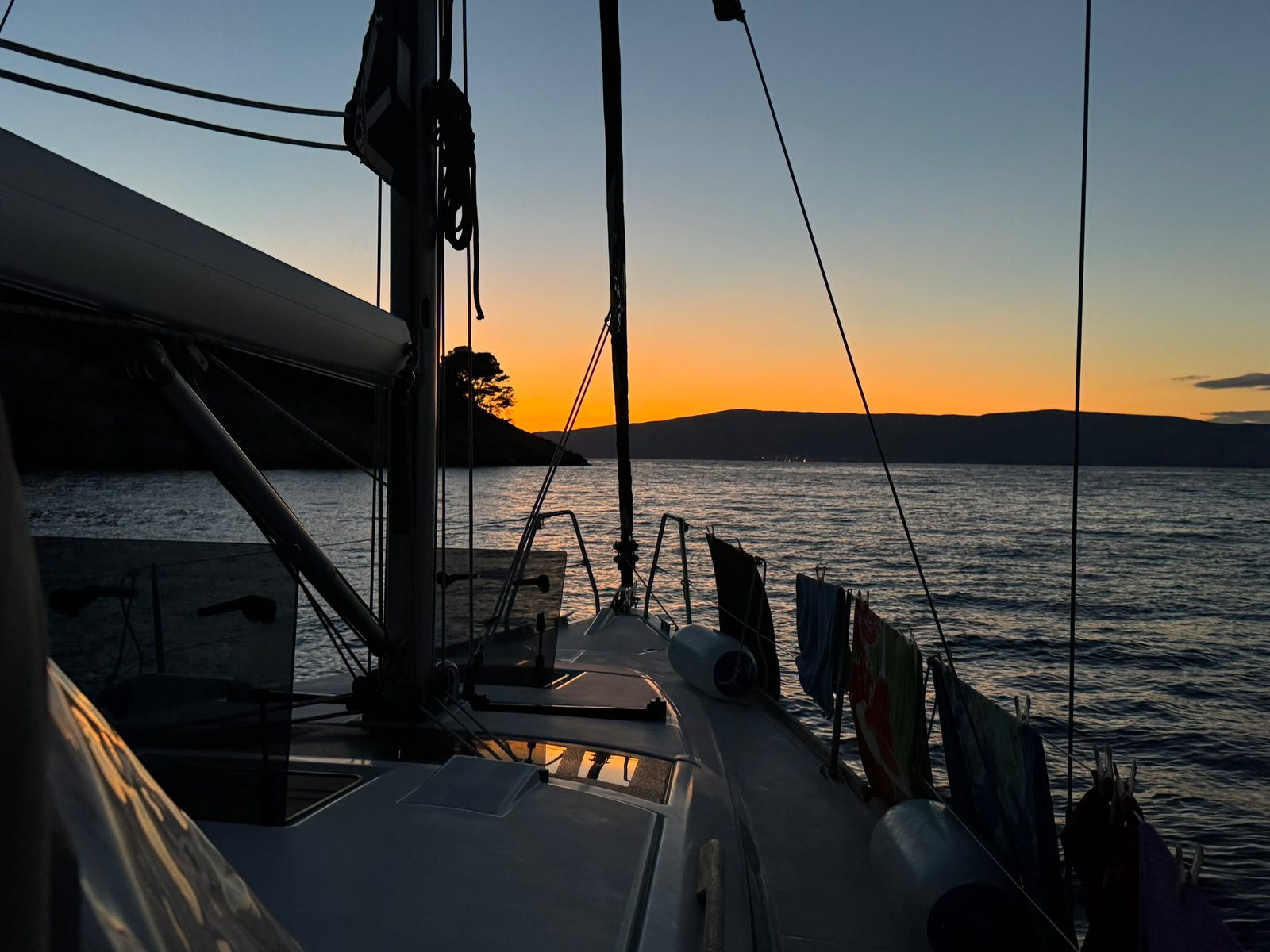
Fuel, one more pod of dolphins, and home
A morning's refuel at Rogač on Šolta and then the slow road home, in no particular hurry to end it. One more bay, one more long stop — and, as though the sea had decided the ending itself, one more meeting with dolphins along the way. Then the familiar mouth of ACI Marina Trogir, where the whole loop had begun six days before.
Six days, a full circle of the islands, one storm dodged, one sail jammed, and one very long night at anchor. Nothing broke that couldn't be mended, nobody was hurt — and if you ask the boys, that night off Drvenik was the best part of the entire week. These are exactly the things that turn, back home around the table, into the stories you tell for years.
Dufour 360 · “Sileb”
Dufour 360 · “Sileb”
Charter · 2019
What the log remembers
We kept the whole week by hand — a fix roughly every hour, wind, course, and a little "M off" scrawled wherever the engine died and a bay began. Plus a second notebook of everything else: the mistakes, the numbers, the stories. It's a lovely, old-fashioned thing to do. It's also a pile of paper that quietly fades in a drawer.
So back home, the paper log became a digital one. Every anchorage a pin on the map; every "M off" an anchor spot, complete with the hours we stayed — that night in Kokošinje very much included. All of it in Sailing Log, and then turned into a book we can actually hand around the table. This story is that logbook, read out loud.
The offline logbook that becomes a story
Log your trip on the water — GPS fixes, anchorages, weather, a fair cost-split for the crew — all offline, no signal needed. Then Sailing Log turns the whole voyage into a beautiful, shareable book, exactly like this one. Buy it once, keep it forever, no subscription — in 27 languages.
 Scan to download · sailinglogapp.com

More journals and charter tips: the Sailing Log Journal · follow along @sailinglogapp.