

A great week afloat is decided months before you smell the sea — at the moment you pick the boat and the dates. Get those two right and everything downstream is easier. Here's how we approached it for six of us sailing out of Athens.
We'll get to where we're going in a later post. This one is the boring-but-decisive part nobody photographs: matching a boat to your crew, understanding how a charter is sold, decoding every fee (transit log, tourist tax, that scary deposit), picking the right week, and lining up the paperwork so nothing bites you at check-in. Written for a first-timer who's just earned their licence.
How big a boat for six?
Start from the people, not the metres. The simple rule that never fails: one cabin per couple or pair, and don't count the saloon as a real bed. A saloon "berth" is a last resort, not a bedroom. So for our six, we wanted three proper double cabins — everyone with a door, nobody sleeping on the dinette.
Six people on a three-cabin yacht is comfortable; eight on the same boat is doable but tight. In practice that points you at a 40–45 ft monohull — big enough for space and tankage, small enough to handle short-handed while half the crew is still learning. Two heads matters at this size, too: one bathroom for six turns into a queue.
How a charter is actually sold
Two different questions get muddled here: what kind of boat, and how it's sold. Take them one at a time — especially if you've just earned your licence and this is your first booking.
The boat: monohull vs catamaran. A monohull is the classic single-hull yacht — heels over when it sails, cheaper to charter and to berth. A catamaran has two hulls: much more space and stability, private cabins, shallow draught — but noticeably pricier to rent and to moor. For a keen crew on a budget, a monohull is the usual pick. We went monohull.
How it's sold is the part nobody explains in sailing school. There are five common ways:
Every fee, explained
The big number in the listing is the base charter fee — the boat for the week, and almost never the total. Here's everything else that lands on the final invoice, in plain language:
Figures above are typical ranges for a ~42 ft yacht and vary by country, company and season — always read the exact breakdown on your offer before you pay.
Deposit & damage waiver
The security deposit (a.k.a. damage deposit or "caution") is money the company can keep if you damage the boat. It's pre-authorised (blocked) on the skipper's credit card at check-in — for a 42-footer typically €1,500–3,000 — and released in full a week or two after check-out if all is well. It's not an extra cost if nothing goes wrong; it's a safety net for the owner. You have three ways to handle it:
What actually gets deducted? Lost or broken gear (fenders, winch handles, the dinghy), a grounding, prop or sail damage, returning late, coming back without refuelling, or missing items from the inventory. Your protection is simple: at check-in, photograph and film the whole boat, and note every existing scratch on the check-in inventory before you sign. Do the same at check-out.
When to book, and when to sail
Two different clocks. Book early — the best boats and best prices go in winter and early spring (roughly January–March). Last-minute deals exist, but you're picking from leftovers. Sail the shoulders — June and September give you warm water and lighter crowds; July–August is peak (hot, busy, priciest). We're going late-August into September: the sweet spot, with an eye on the Meltemi.

What to check before you commit
The details that make or break the week
We run every listing through this before paying a deposit.
- ✓Cabins, berths & heads. Enough real cabins for your crew, and two heads once you're six-plus.
- ✓Age & engine. A newer hull (say 2018+) with healthy engine hp means fewer surprises and confident motoring in a calm or a blow.
- ✓Water & fuel tanks. Six people drink and shower a lot — a bigger water tank means fewer marina stops just to fill up.
- ✓Sails. Furling main + genoa = easy, short-handed sailing for a mixed crew.
- ✓Extras. Bimini & sprayhood (shade!), dinghy + outboard, A/C, SUP/snorkel gear, transom platform. Check what's included vs paid.
- ✓Deposit & insurance. Know the security deposit and whether a damage-waiver is offered — it changes the risk maths for a bareboat.
- ✓Base & check-in. A base near the airport (like Alimos for Athens) saves a travel day at each end.
"You don't choose the trip and then the boat. You choose the crew, then the boat, then the week — and the trip almost plans itself."
Bavaria C42 “Josef”
Bavaria C42 · “Josef”
Bareboat · 2021It ticks the boxes: a recent (2021) 42-footer, three cabins so our six each have a proper bunk, two heads to kill the bathroom queue, furling sails for the mixed-experience crew, and a healthy water tank. Bareboat, from an Athens base a short hop from the airport. On paper, exactly the trip we wanted.
What to prepare
The pre-trip admin (do it early, not at the marina)
None of it is hard — it just all has to be done.
- ✓Skipper's licence & sailing CV. Bareboat bases want the skipper's certificate (and often a co-skipper) plus a short experience form. Have scans ready.
- ✓Crew list & IDs. Full names and passport/ID details — the base files these with the port authority.
- ✓Deposit & damage waiver. Decide waiver vs full deposit; sort the card and the insurance before you fly.
- ✓Money split & kitty. Agree how you'll share fuel, marina fees, food and the deposit — before anyone's tired and hungry.
- ✓Provisioning plan. A rough menu and a big-shop list for the base supermarket beats improvising on day one.
- ✓Open the logbook. Start the trip in Sailing Log, add all six crew, switch on the cost-split — then it records the week for you.
Set the trip up once — it does the rest
Add the boat and the crew in Sailing Log and it's ready to log the week offline: GPS track, anchorages, weather, and a fair cost-split among all six — then it turns the trip into a beautiful PDF/HTML book. One-time €24.99, no subscription, 27 languages.
 Scan to download · sailinglogapp.com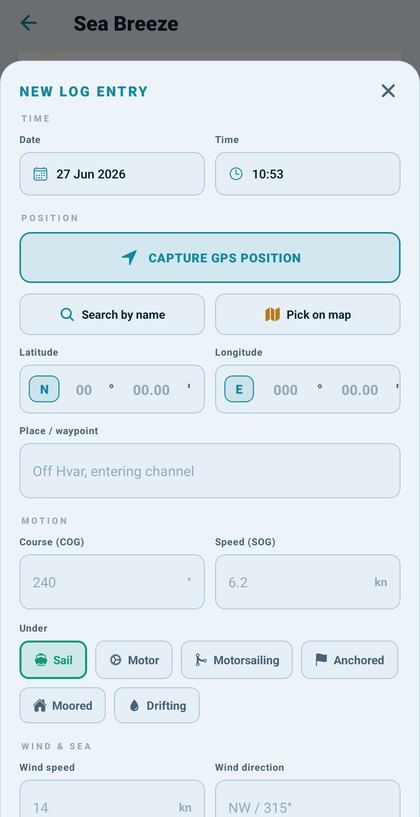

Next in the series: provisioning & the crew brief — then the route. Follow along @sailinglogapp.